
When Should You Use the Y6 Attendance Code?

Y6 is an interesting code. It’s a statutory attendance code to be used when a child is “unable to attend in accordance with public health guidance or law”.
But until now, it hasn’t been clear exactly when schools could use it.
On the face of it, it looks like the DfE is making sure it’s prepared for another pandemic. But we suspected there could be a more immediate impact on school attendance – so we asked the DfE when it can really be used.
Where Did the Y6 Code Come From?
In August 2024, the DfE introduced a set of new attendance codes designed to make recording attendance more accurate and nuanced. This included replacing the single Y code (unable to attend due to exceptional circumstances) with a set of more specific codes, including Y6:
Y6: Absence due to public health guidance or law (e.g., mandatory infection control rules).
Why Y6 Is Significant
With our focus on illness absence, Y6 always stood out to us. Was it just there in case of another pandemic, or could it cover everyday cases like the isolation days after chickenpox?
If it was the latter, then instead of coding every day of a chickenpox absence as
The same code could also be used for vomiting/diarrhoea, measles, scarlet fever, whooping cough…
The wording suggested Y6 could be used this way, but we didn’t want to advise schools to do this without being sure.
A Step Towards Clarity
When the statutory guidance was reissued in August 2026, one of the updates was to clarify the Y6 code.
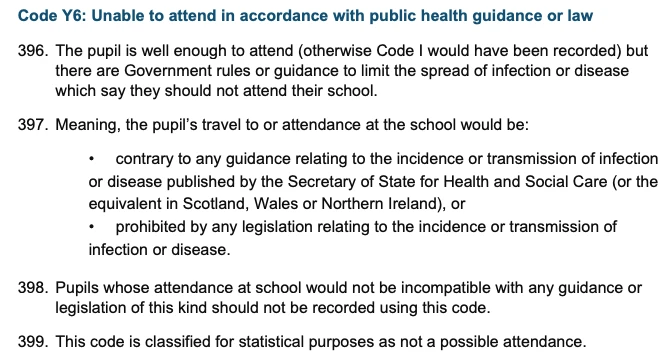
The amendment cleared up that this code should only be used where guidance or legislation would prevent a child attending. But we were still unsure what guidance exactly it referred to – was it just pandemic-style lockdowns or did it also include UKHSA guidance on keeping children off school for illness?
Studybugs Gets a Clear Answer
The DfE attendance team’s reply proved our hunch right:
Where a pupil is absent because they are unwell, code I (illness) should be used. However, there may be circumstances where a pupil is otherwise well enough to attend school but is required by public health guidance to remain away from the setting for a specified period. In those circumstances, code Y6 may be appropriate for the relevant sessions.
For example, current UKHSA guidance on public health exclusion periods states that individuals with diarrhoea and vomiting should remain away from the setting until two days after the diarrhoea and vomiting have stopped. It also specifies exclusion periods for infections including chickenpox and measles. If a pupil remains absent during such an exclusion period because their attendance would be contrary to that guidance, rather than because they remain too ill to attend, Y6 can be used for those sessions.
Schools should therefore apply the code according to the reason the pupil is unable to attend for each session. This may mean that code I is used while a pupil is ill, followed by Y6 for any subsequent period when the pupil is well enough to attend but remains subject to a public health exclusion period.
So there you have it.
So What Does This All Mean for Schools?
Essentially, it means that some absences you’re currently recording as
And because
Take a child who catches a 24-hour stomach bug. Following UKHSA guidance, they need to stay off for a further 48
hours after their symptoms stop. Recorded as
This also has the welcome knock-on effect of preventing the spread of illness.
We know several schools that follow a 24-hour rule for vomiting and diarrhoea instead of UKHSA’s 48 hours. We understand why: schools want children in class as much as possible, and absence is heavily scrutinised. But children who come back while still contagious can pass it on to more pupils and staff.
By using the Y6 code appropriately, schools can strictly follow health guidelines while improving their overall attendance score.
How Do I Start Using the Y6 Code?
First, identify the absences where Y6 could apply. That means watching absence reports for vomiting, diarrhoea, chickenpox and any other illness with a public health exclusion period – the UKHSA’s full list is here.
Or you can let Studybugs do it for you. Because parents tell us the reason for their child’s absence directly,
Studybugs can now automatically apply the right code –
Not using Studybugs yet? The platform is free for schools, with a range of optional paid add-ons.
A Welcome, Positive Change
All in all, this is a welcome clarification that could fundamentally change day-to-day reporting for some of the most common reasons for absence. Most significantly for schools, it should improve the accuracy of recording attendance while also giving you a more realistic picture of whole-school attendance.
So, is it time to start using this code? Book a meeting with one of our expert consultants – all former school leaders – to see how Studybugs can handle Y6 for your school.
Already a Studybugs school?
Studybugs is part of the UKHSA’s illness monitoring network and works with them on campaigns such as flu and chickenpox vaccination.
— Lucas Abbott